from
$150.80
from
$150.80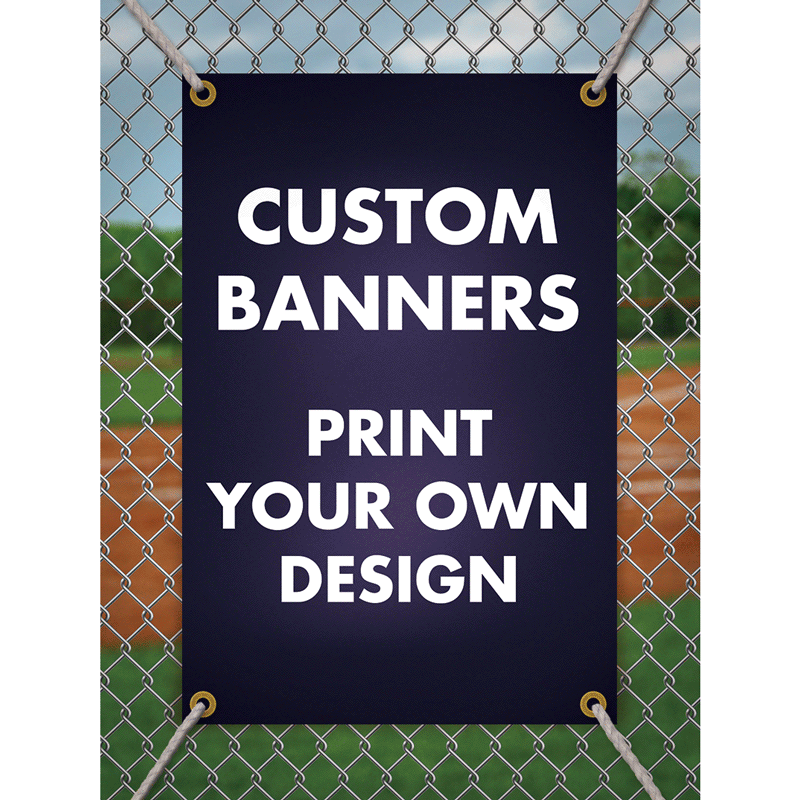 from
$21.32
from
$21.32



 from
$499.00
from
$499.00 $279.95
 $179.95
 $199.95
 $289.00
 from
$931.65
from
$931.65 $197.12
 from
$16.99
from
$16.99 $344.96
 $279.00
Choosing the right photography backdrop size can make a big difference in how easily you can pose, light and photograph your subjects.
The best backdrop size depends on what you photograph, how many people are in the image, whether you are shooting full-length portraits and how much distance you want between your subject and the background.
A backdrop that is too small can limit posing and camera angles. A slightly larger backdrop usually gives you more flexibility as your photography needs change.

Here is a simple starting point:
Headshots: 5' x 6' to 6' x 8'
Individual portraits and three-quarter portraits: 8' x 10'
Couples and small groups: 8' x 10' to 10' x 10'
Full-length portraits: 8' x 16' or larger
Families and groups: 10' wide or larger when possible
These are general guidelines. Your ideal backdrop may be larger or smaller depending on your studio, lens, shooting distance and composition.
For traditional head-and-shoulder portraits, you usually do not need a very large photography backdrop.
A backdrop around5' x 6' or 6' x 8' can provide enough coverage for many individual headshots.
Smaller backdrops are especially useful for:
Corporate headshots
School portraits
Professional profile photos
Passport-style photography
On-location portrait sessions
Small home studios
If you plan to photograph wider compositions or want more room to position the subject away from the background, consider moving up to a larger size.
For individual portraits that include more of the body, an8' x 10' backdrop provides considerably more flexibility.
This size works well for:
Senior portraits
Children's portraits
Maternity photography
Three-quarter portraits
Seated portraits
Branding photography
An 8-foot-wide backdrop gives photographers more room to adjust camera angles without immediately seeing the edge of the backdrop.
If you frequently shoot full-body portraits, however, additional length is helpful.
For full-length portraits, Denny Mfg. generally recommends an8' x 16' backdrop or larger.
The additional length allows part of the backdrop to extend onto the floor, creating a smooth transition behind and beneath the subject.
This extra floor coverage is often called asweep.
A longer backdrop gives you more flexibility for:
Standing portraits
Seated portraits
Children's photography
Senior photography
Fashion photography
Maternity photography
Full-body branding sessions
It also allows you to move your subject farther away from the backdrop while still maintaining coverage.
If full-length photography is an important part of your business, buying extra length usually gives you more flexibility than trying to work with a backdrop that is too short.
Couples require more horizontal space than individual portraits.
An8-foot-wide backdrop can work well for many couples, particularly for close or three-quarter portraits.
A10-foot-wide backdrop gives you more freedom to:
Space subjects apart
Create different poses
Photograph from wider angles
Include furniture or props
Move the couple farther from the background
If you regularly photograph couples and families, choosing a wider backdrop can make your studio setup more versatile.
Family photography usually requires more backdrop width.
For small families, an8-foot-wide backdrop may provide enough coverage depending on the pose and composition.
For larger families, a10-foot-wide backdrop or larger gives you more room to arrange subjects naturally.
When choosing a family photography backdrop, think about more than the number of people.
Consider whether you use:
Benches
Chairs
Stools
Children's props
Holiday set pieces
Floor props
Decorative elements
These items take up additional width and may require a larger background than you would need for the subjects alone.
As group size increases, backdrop width becomes increasingly important.
For teams, large families, dance groups, school groups or other multi-person portraits, choose the widest background your studio and mounting system can comfortably accommodate.
A wider backdrop gives you more flexibility to create multiple rows and posing arrangements without having to tightly compress everyone into the center of the image.
When photographing large groups, also consider how far back your camera must be positioned. As your field of view becomes wider, the edges of a small backdrop become easier to see.
Photographers often focus on backdrop width, but length can be just as important.
A backdrop that only reaches the floor may work for headshots and upper-body portraits.
For full-length photography, you generally want enough material to travel down the wall or backdrop stand and then extend forward onto the floor.
This creates a continuous background behind the subject and underneath their feet.
A longer sweep also provides more flexibility when photographing children, pets or seated subjects closer to the floor.
A backdrop sweep is the portion of the backdrop that extends from the vertical background onto the floor.
Instead of creating a sharp corner where the wall meets the floor, the material curves gently toward the camera.
This helps create a more seamless appearance in the photograph.
The amount of sweep you need depends on:
Subject height
Subject position
Camera angle
Lens choice
Whether the subject is standing or seated
Whether props or furniture are included
This is one reason photographers who shoot full-length portraits often choose a 16-foot-long backdrop or larger.
There is no single required distance, but moving your subject away from the background can improve many portraits.
Greater subject-to-background distance can help:
Reduce shadows on the backdrop
Create better subject separation
Soften printed backdrop details
Blur background texture
Make lighting easier to control
Create more visual depth
Depending on your lighting setup and available studio space, photographers may position subjects several feet in front of the backdrop.
The farther the subject moves forward, however, the more backdrop coverage you may need because the camera's field of view becomes wider.
That is another reason a slightly larger backdrop can provide greater flexibility.
Lens choice affects how much of the scene appears in your photograph.
A wider-angle lens includes more of the surrounding environment and can reveal the edges of a backdrop more easily.
A longer focal length generally creates a narrower field of view.
For example, photographers working in small studios may need to use a wider lens because they cannot move the camera very far away from the subject.
In that situation, a wider backdrop can make it easier to keep the background filling the entire frame.
Your studio dimensions, lens choice and working distance should all be considered when choosing backdrop size.
The orientation of your final image also matters.
A backdrop that provides plenty of coverage for a vertical portrait may not provide enough width when you turn the camera horizontally.
Vertical photographs generally require less backdrop width.
Horizontal photographs require more.
If you frequently photograph families, couples or groups in landscape orientation, choosing additional backdrop width can help prevent the edges from entering the frame.
In many cases, yes.
A larger backdrop gives you more room to:
Change posing
Photograph additional people
Add props
Shoot horizontally
Move subjects farther from the background
Change lenses
Photograph full-length portraits
A photographer who currently specializes in headshots may eventually add family portraits or senior sessions.
Choosing a backdrop with enough coverage for future photography needs can make it more versatile over time.
However, bigger is not always better if portability and storage are your primary concerns.
Photographers working on location may prefer a smaller backdrop that is easier to transport.
In a small studio, measure the space before ordering your backdrop.
Consider:
Ceiling height
Available wall width
Distance from backdrop to subject
Distance from subject to camera
Backdrop stand width
Lighting equipment
Furniture and props
You should also allow room around your backdrop stand for lights and other equipment.
A large backdrop can be useful, but it needs enough space to be used effectively.
For small studios that primarily photograph individuals and headshots, a 6-foot or 8-foot-wide backdrop can often provide a useful balance between coverage and space.
Mini sessions vary dramatically depending on the set.
For simple individual or children's portraits, a smaller backdrop may be sufficient.
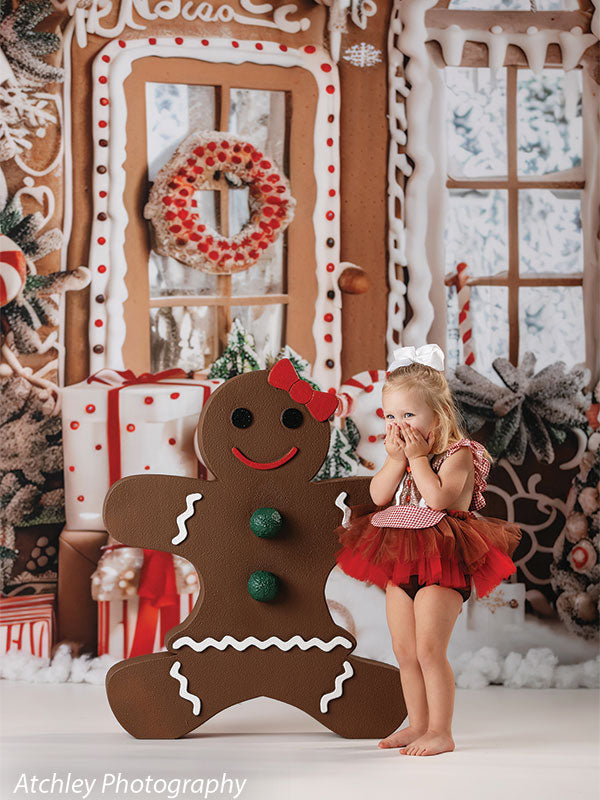
For holiday mini sessions with furniture, benches, trees, presents or decorative props, you may need significantly more width.
Before choosing the backdrop, plan the entire set.
Measure the total width of:
Furniture
Props
Decorations
Subject area
Then give yourself additional space on both sides so the edges of the backdrop do not appear in the photograph.
On-location photographers have to balance coverage with portability.
Smaller backdrops are:
Easier to transport
Faster to set up
Easier to fit into tight spaces
Larger backdrops provide:
More posing freedom
More group capacity
More camera-angle flexibility
Portable materials such asFreedom Cloth can make larger backgrounds easier to transport because the fabric can be folded for storage. Denny's Freedom Cloth is a 100% polyester backdrop material that is designed to be wrinkle resistant, washable and suitable for compact storage.
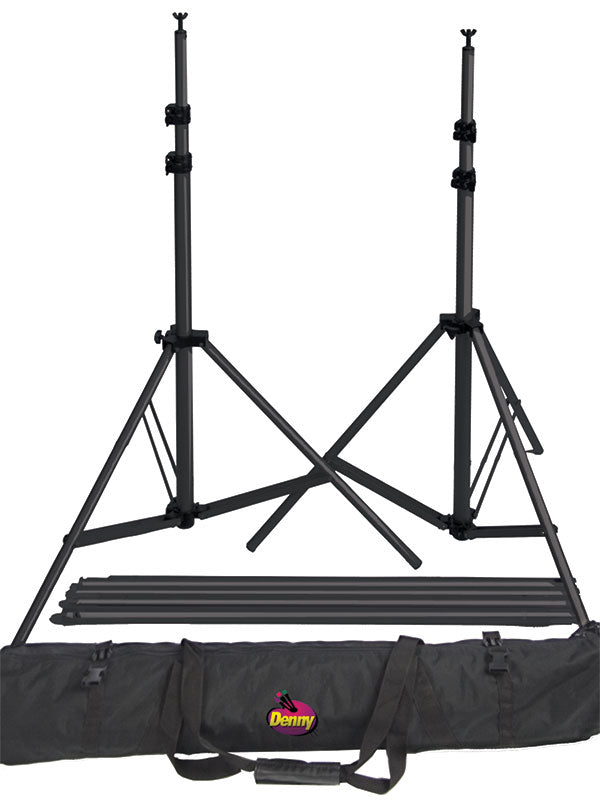
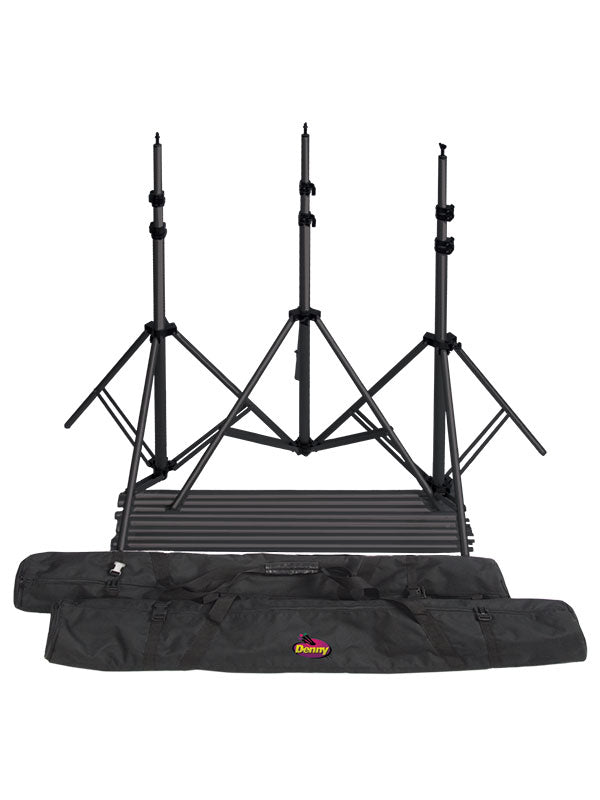
Before ordering a backdrop, confirm that your backdrop stand or mounting system can support the width you choose.
Portable backdrop stands have maximum width and height limits.
Permanent studio systems may support significantly larger backgrounds.
You should check both:
Maximum crossbar width
and
Maximum backdrop height
before purchasing a backdrop.
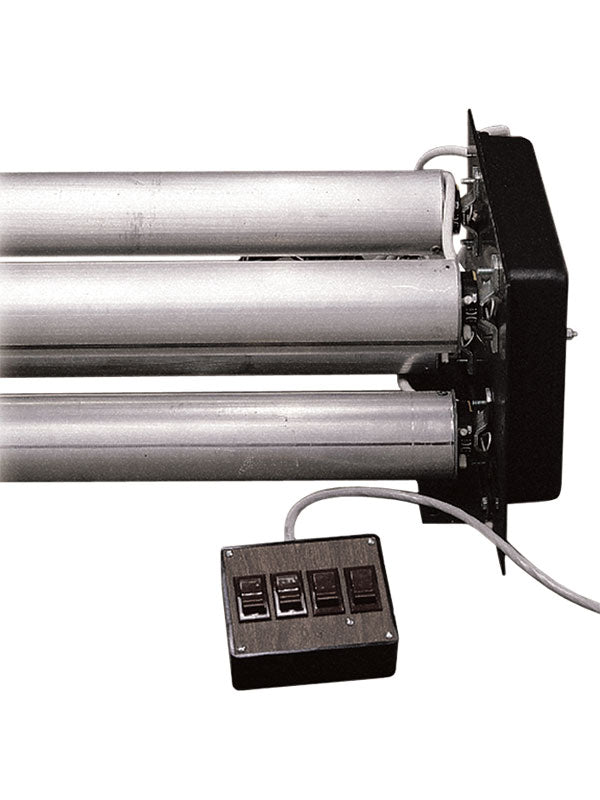
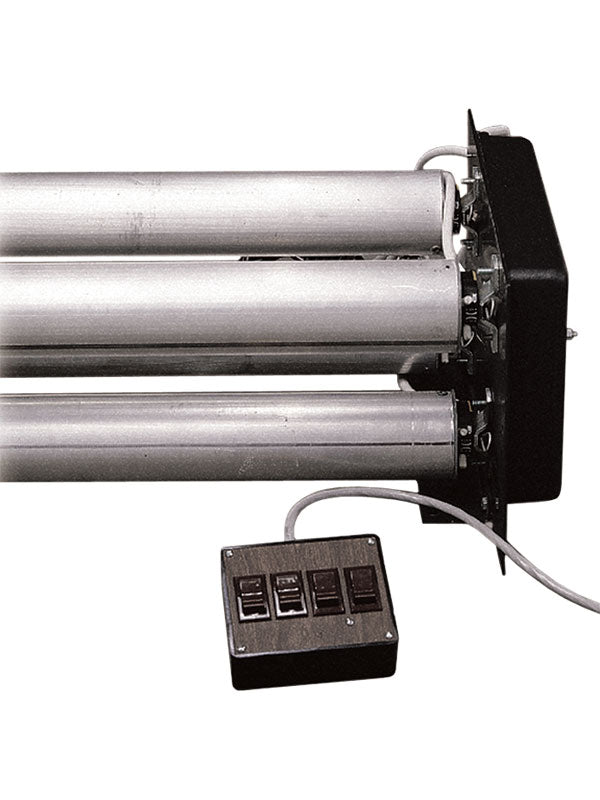
If you regularly use multiple backgrounds, a studio backdrop lift or roller system may provide a more permanent solution.
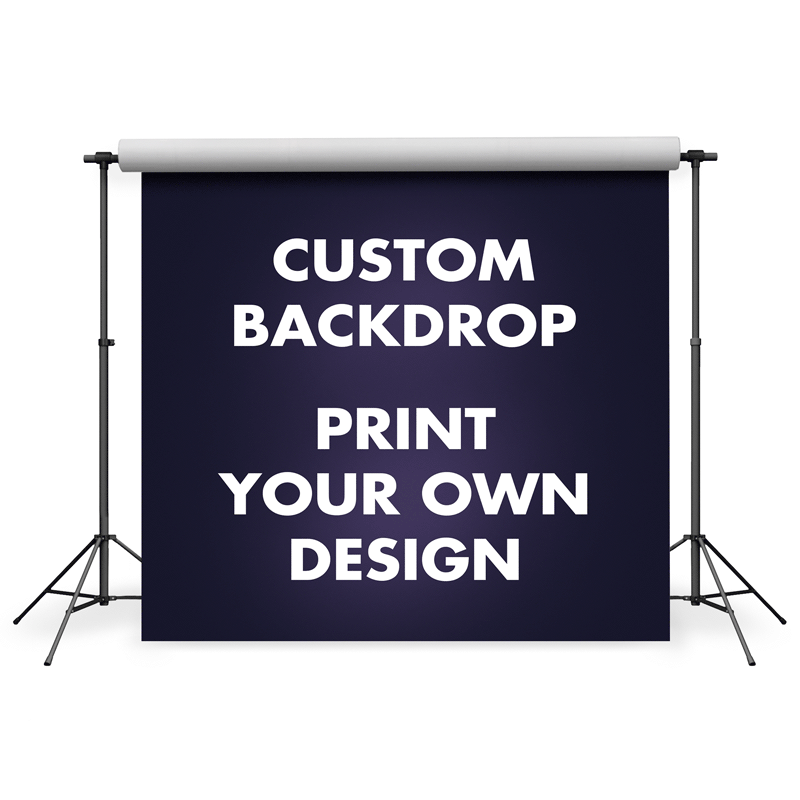
Custom backdrops should be sized according to how the final image will actually be photographed.
For custom designs, consider where the important parts of the image will appear.
For example, avoid placing critical design elements too close to the outer edges where they may be cropped.
For branded backgrounds or step-and-repeat designs, remember that people will cover parts of the backdrop.
Repeating logos or design elements across the background can help maintain visibility in the finished photographs.
Denny Mfg. can produce custom photography backdrops in a wide range of sizes and materials.
If your studio or project requires a specific dimension, a custom photography backdrop may be the best solution.
Custom sizing can be especially useful for:
Permanent studio installations
Events
Step-and-repeat backgrounds
Large group photography
Specialty sets
Unusual studio dimensions
Denny Mfg. offers custom backdrop printing for photographers, businesses and events.
A backdrop around this size can work well for individual headshots, children and tighter portraits. It generally provides less flexibility for full-body portraits, couples or groups.
An 8' x 10' backdrop is a versatile size for many individual portraits, children, seniors, couples and smaller compositions. Full-length photography may benefit from additional length to create a floor sweep.
For full-length photography, Denny generally recommends approximately8' x 16' or larger so the backdrop can extend onto the floor and provide more working room.
An 8-foot-wide background may work depending on the pose, but a 10-foot-wide backdrop gives you more flexibility for arranging the family naturally and photographing horizontally.
A 10-foot-wide backdrop or larger is generally more practical for larger families. The exact size depends on posing style, props and camera distance.
Not necessarily. A 10-foot backdrop provides more horizontal coverage, while an 8-foot backdrop may be easier to transport and fit into smaller studios. Choose based on your subjects and available space.
There is no universal amount. Full-length portraits require enough material to extend in front of the subject and remain within the camera frame. A longer backdrop gives you more flexibility for creating a smooth sweep.
Yes. The backdrop should extend beyond the portion visible through the camera so that slight changes in posing or camera position do not reveal its edges.
The easiest way to choose a photography backdrop size is to think about the largest type of session you regularly photograph.
If you mainly photograph headshots, a compact backdrop may be all you need.
If you photograph seniors, couples and families, an 8-foot or 10-foot-wide backdrop gives you more flexibility.
If you photograph full-length portraits, look for additional length so the background can extend onto the floor.
When possible, choose enough backdrop coverage to allow your photography style to grow rather than limiting yourself to one specific composition.
Denny Mfg. has been manufacturing professional photography backdrops and studio equipment since 1971, with backdrop sizes and materials designed for portrait studios, traveling photographers, events and custom installations.
Not sure which backdrop material is best for your studio?
Read our Photography Backdrop Material Guide
Want help choosing a backdrop based on your overall photography needs?
Visit our Photography Backdrop Buying Guide
Looking for a unique size or design?
Explore Custom Photography Backdrops
Ready to find your next background?